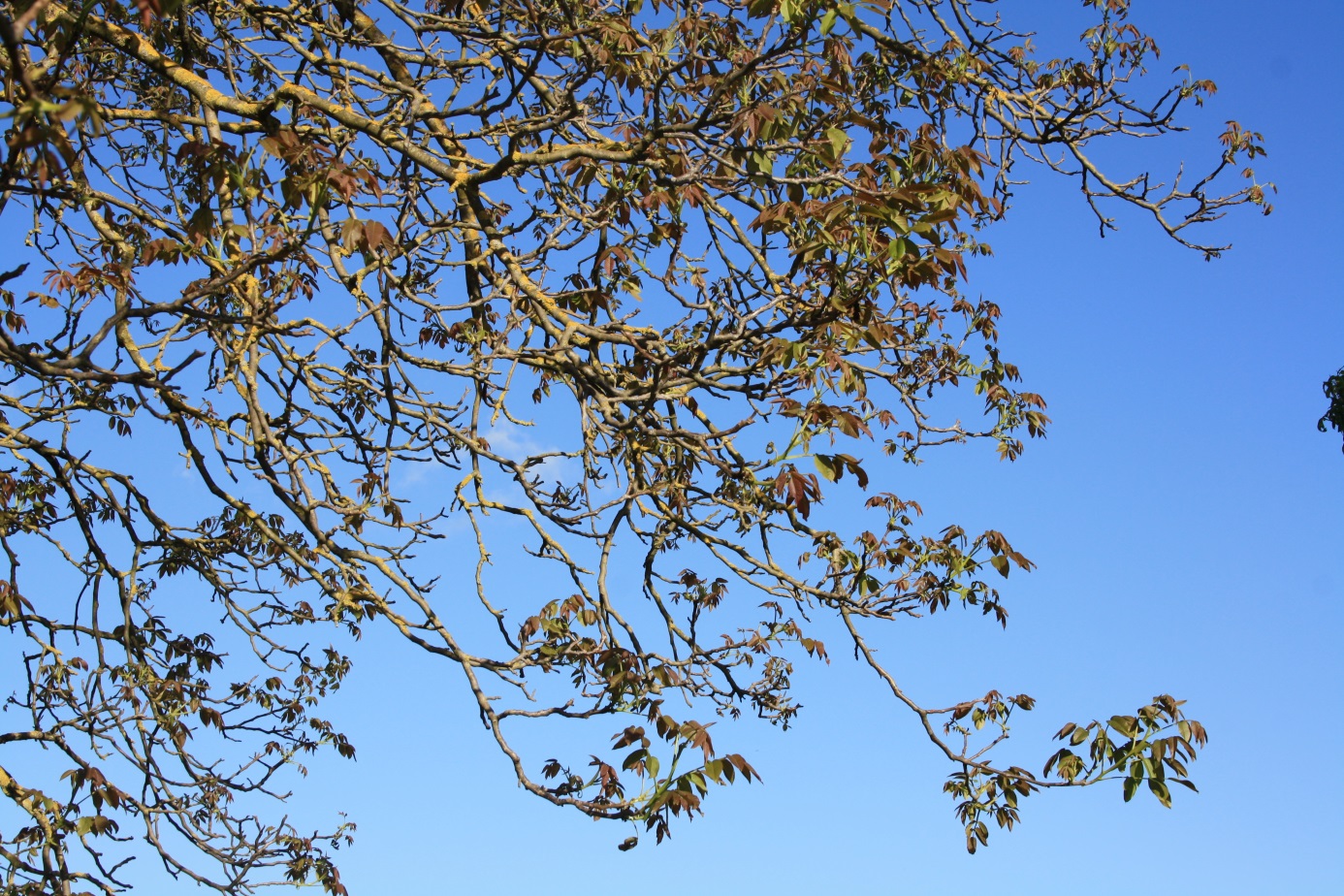
Als einer der letzten hiesigen Laubbäume öffnet die Walnuss ihre Blätter und zeigt dann ihre unscheinbaren weiblichen Blüten. Der Wind trägt den Blütenstaub der gelbgrünen männlichen Blütenkätzchen. Hier an der Mosel reifen die Walnüsse etwa zeitgleich mit dem Riesling im Oktober.
Vor der Eiszeit wuchsen wilde Walnüsse in ganz Europa – und überdauerten die kalten Epochen auf dem Balkan und in Vorderasien. Plinius (ca. 23 bis 79 n. Chr.) berichtet in seiner Naturalis historia, die Griechen hätten den Baum im 7. bis 5. Jahrhundert vor Christus nach Europa gebracht. Die Römer brachten ihn zu uns. In Weinbauklima fühlen sich Walnussbäume besonders wohl – starke und Spätfröste ruinieren sie. Spanische Missionare brachten den Baum 1770 in die Neue Welt. Im Jahr 1867 wurde in Kalifornien die erste Walnussplantage angelegt, erfolgreich – heute ist das Land der größte Walnussexporteur der Welt. Weltweit werden derzeit auf 82.000 Hektar Walnüsse angebaut. Trotz des hochwertigen Holzes wird sie forstwirtschaftlich kaum genutzt – die Walnuss ist eine konkurrenzschwache Lichtbaumart und passt nicht in gängige Waldbaukonzepte.
As one of the last local broad-leaved trees the walnut opens her sheets and then shows her insignificant female blooms. The wind carries the pollen of the male flower kittens. Here on the Moselle the walnuts mature possibly at the same time with the Riesling in October.
Before the ice age wild walnuts grew in whole Europe – and outlasted the cold epochs in the Balkans and in the Near East. Plinius (from approx. 23 to 79 A.D. ) reports in his “Naturalis historia”, the Greeks would have brought the tree from the 7th to the 5th century B. C. to Europe. The Romans brought him to us. In wine-growing climate walnuts feel fine – strong and late frosts ruin them. Spanish missionaries brought the tree in 1770 in the New World. In 1867 the first walnut plantation was put on in California, successfully – today the country is the biggest walnut exporter of the world. Worldwide are grown currently on 82,000 hectares of walnuts. In spite of the high-quality wood it is hardly used in forest – the walnut is a competition-weak light type of tree and does not fit in current forest construction draughts.
 Biodiversity at Moselle - Biodiversité des terroirs de la Moselle viticole